Showing posts with label garden care. Show all posts

Friday, January 15, 2016

Irrigation Systems

This week part of the Staghorn team, Colin and I, had the thrilling experience of attending a course at the New York Botanical Gardens about irrigation systems. Irrigation systems are a great idea if you have a landscaped property and you want to keep it looking nice while also conserving water. This is a little guide to some of your options for irrigation.


Underground Sprinkler Systems
This system is best installed before landscaping is done. Parts of the landscape will need to be dug up and replanted if not. Your plants will need to be organized into hydrozones; plants with similar water needs should be grouped together. Each zone will be on it’s own timer and have different sprayer heads that fit to that hydrozone’s needs.

An example of different hydrozone areas
Pros
  • Good for large spaces and lawns
  • Very far spray range
  • Pop up sprayer heads are available so they can be out of sight when not in use
Cons
  • High water usage
  • Sprayer heads are easily broken by foot traffic, vandalism or mowers
  • Water loss from overspray and evapotranspiration
  • Can only be on certain hours or plants can become scorched
  • Needs higher water pressure


Drip Irrigation
This system involves laying tubing throughout or under the planting area. The tubing has drip holes which allows water to slowly seep out into the ground around the plants. If the tubing is underground, trenches are dug and the piping is laid in a grid, covered and then planted. If it is above ground, the piping can be laid around the planted area and then covered with mulch.
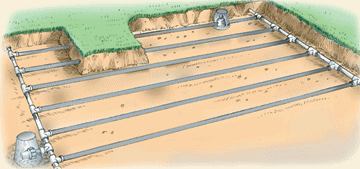
Drip layout under sod
Pros
  • Can be fit into any shape or size area
  • Can be installed underground or above
  • Can be added to old sprinkler systems
    • There are adapters available to turn sprayer heads into dripline connectors
  • Great for water conservation
    • Uses far less water than sprinkler systems
  • Easy to find and fix damaged tubing
  • Works with low water pressure
  • Water goes directly where you need it
    • It is not wasted through evaporation, wind, or surface run off
Cons
  • It may be hard to see that the ground is getting wet
    • Since the piping is underground or under mulch, the surface may look dry even though it’s damp below

Microdrip lines off of larger tubing
MicroDrip Irrigation

Microdrip is great for small gardens, rooftops, balconies, container gardens, or being very specific for a certain plant’s watering needs. It uses smaller tubing than normal drip irrigation. This allows you to plug into the larger drip tubes anywhere along the tube and feed water directly where you want it to go. Emitters are added to the ends which allow you to choose specific water flow to each plant.


Friday, November 20, 2015

Putting the Garden to Bed

This fall has been pretty warm. In fact, this October was the warmest on record. So, many of your gardens may still be going strong. Though as I write this it is 62 degrees outside, the temperatures will soon fall. This weekend the lows at night will start to hit the 30s. This signals it is time to start  putting the garden to bed. Thoroughly cleaning up the garden and readying it for winter is important for a healthy spring garden. Here are some things you

Mulch 
If you have planted fall plants or bulbs, you probably have already mulched(or should have). If you haven’t, now is the time. Adding a nice layer of mulch to your garden gives extra protection to your plants. It also adds nutrients to the soil as it breaks down over time. Be sure to choose natural mulch and not that funky dyed mulch that’s full of chemicals that you don’t need to be putting in your garden or the water supply. Check out Better Home and Garden for the best types of mulch.


Blow out irrigation systems
If you have an irrigation system, you probably don’t want it to freeze and crack over the winter. To prevent this, you want to get out all of the water. To do this you can use an air compressor to blow it out. The pressure you use depends on the type of irrigation system you have (a maximum of 80 psi for rigid PVC pipe systems, or 50 psi for flexible black polyethylene pipe). If you have a timer on your hose, disconnect this and bring it inside.
If you don’t have an irrigation system, you still want to keep your hoses from freezing. Make sure to get all the water out before putting them away.

Clear and compost dead plants
The point of clearing away dead plants is to keep the garden clean. Leaving dead plant debris in the garden can cause the spread of disease and give insects a great place to breed. If the plant has died because of what looks like disease, do not compost this. Never put diseased plant material in the compost. But definitely compost all other plant materials. I know you have plenty of leaves by now for it. A nice hot compost pile will kill off the pathogens and convert the garden debris to a usable fertilizer in the future, so don’t throw all that debris away!

Cut back perennials
After a few frosts, cut back perennials to about 3-6 inches. If they are still green and are going strong, leave them be until they start to wither. The plant gets it’s energy from the sun through it’s leaves. As long as the leaves are green, they are collecting and storing energy. They need as much as they can gather to get through winter. Your plants most likely will not all turn at the same time, so this will be an ongoing process.
Some perennials are super cold tolerant and won’t need to be cut back. You can also leave stems with attractive seed heads for winter interest and to feed wildlife.
Ornamental grasses, though they change color, still look great throughout the winter. These can be left and then cut back in late March.

Clean out and store small pots
Small pots left outside during the winter months have a high risk of cracking and breaking as they freeze and thaw(especially terra cotta). Unless you can bring these potted plants inside, it’s best to empty them and wash them out for next year. Washing out your pots is important for not spreading disease. While you’re at it, you might as well give all your garden tools a nice scrub down so everything is nice and fresh in the spring. This is also a great time to organize all your tools. Your future self will thank you. (: