Showing posts with label staghorn. Show all posts

Friday, April 8, 2016

Meet the Team!

The Staghorn Crew


Katherine Aul,                    Founder & Principal
Katherine’s passion for plants and landscape design began from an early age amidst the daylily beds of her mother’s garden. After completing a horticultural internship at the New York Botanical Garden she went on to receive her master’s degree in Landscape Design from Columbia University. Since then, she has been designing and installing gardens throughout the NYC metro area and beyond.

Katherine finds inspiration in the wild, native landscape. She seeks to create sustainable garden spaces that are beautiful, engaging, and restorative to both the visitor and the existing environment.

Katherine’s enthusiasm for the field has led her to speak on such panels as the 2014 Plant-O-Rama at the Brooklyn Botanic Garden, and her work has also been featured in Dwell magazine.


Dana Boyd,                          Director of Horticulture
Dana’s love for getting her hands in the ground grew when she traveled through Central and South America working on permaculture farms. She continued this work when she returned to the states working on urban farms in Baltimore while getting her degree in Environmental Science.

Seeing the importance of connecting people, especially in urban settings, with the natural world led her to New York City to work as a farm manager for the Horticultural Society of New York. She has now been with Staghorn NYC since April 2015. Working with Staghorn has allowed her to combine her passion for helping the environment and native species by reintroducing habitat, and connecting people with nature.

In her spare time, Dana tends to her extensive indoor plant collection, travels, reads, does lots of yoga, and likes getting into new hobbies, like ceramics!


Colin MacInnes,                    Director of Carpentry
Colin is a renaissance woodsman hailing from Michigan. After completing his education in aviation, Colin switched gears and refocused his talents on agriculture and later carpentry as an apprentice under a master carpenter in his home state. Now a woodworking pro in his own right, he leads carpentry projects for Staghorn ranging from custom outdoor furniture to decks and planters.

In his free time, Colin can be found building high-end interior carpentry pieces, hiking, fishing, cooking, and spending time with his loyal canine companion, Millie.

New Members!


Marisa Prefer, Assistant Gardener
Marisa Prefer is a multi-disciplinary educator, amateur herbalist and designer who explores relationships between land, food & power by building regenerative systems for well being. Marisa has collaborated with artists, farmers, healers and big-thinkers of all ages from coast to coast at the Berkeley Art Museum in Berkeley, California, Local Roots Farm in Duvall, Washington, the Sage Mountain Herbal Education Center in East Barre, Vermont, and more recently in New York as the Assistant Coordinator of Brooklyn Botanic Garden’s Children’s Garden, the Curriculum Developer for SwaleNY, a NYC Master Composter, the Programs Manager at urban agriculture education outfit Sprout Farms, and as part of the artist group non/studio.


Hester Griffin, Assistant Gardener
Hester's love of plants began during her sophomore year of college at the New School when she planted a dye plant garden. This was the first of many gardens and farms that's she's worked on. Her interest in traveling and plants has led her to many amazing places, but she always find herself back in NYC. There's something especially fun about growing plants among skyscrapers and cement.

When Hester's not gardening, she will most likely be found wandering around NYC, cooking, or working on textile projects. She also escapes the city to visit family in Maine and hopefully somewhere warm during the winters!

Friday, April 1, 2016

We Have an Office!

We are super excited to move into our new office at Coworkrs in Gowanus!
New office, new crew!


Have an awesome weekend everyone!


Friday, February 5, 2016

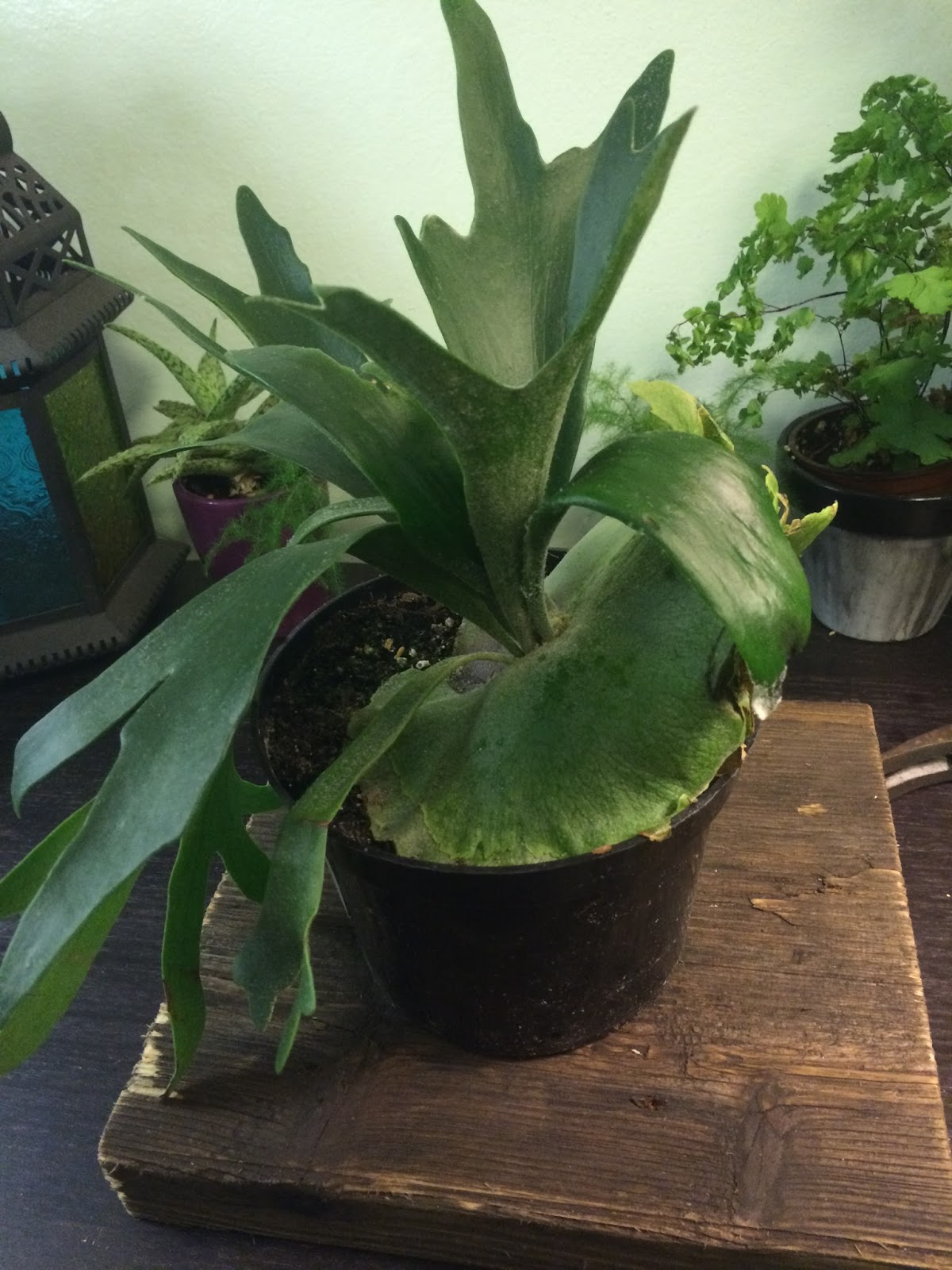
How to Mount a Staghorn Fern

I am lucky enough to be writing this from Mexico and I love jungle plants oh so much, so I thought I'd share a little tutorial on incorporating an awesome tropical plant into your home. Staghorn ferns are members of the Polypodiaceae plant family. They thrive as epiphytes, which are plants that harmlessly grow on another plant, usually a tree, and derive their moisture and nutrients from the air, and rain.

Because they grow on other plants, you must mount your staghorn fern on wood or in a basket. This allows you to hang your staghorn on the wall as a beautiful, growing piece of art. I mounted some for Christmas for my Staghorn NYC teammates and took lots of photos so I could share with all of you!


Step 1: Choose your mounting board. Attach brackets to the back so you can hang your staghorn on the wall when you're done. This will be hard to do at the end without hurting your fern, so do it first!
Step 2: Turn your board over and trace a circle around the base of your pot.

Step 3: Use screws or nails around the circle. You can do more all the way around the circle if you want but I just did four.

Step 4: Gently remove the Staghorn from the soil. Be careful not to break the shield (the brown part at the base). 

Step 5: Put a small pile of soil in the circle you made and cover this with sphagnum moss. This can easily be found at any garden store. It's good to soak the moss in water before you use it. 

Step 6: Place your fern on your pile of moss. Make sure it's facing the direction you want it to grow (check the brackets on the back!). 

Step 7: You should use fishing line to attach the fern but I couldn't find any so I used floral wire that I had(not the best option). Wrap the wire/line around one of the screws. Pull it taught and crisscross around the base of your fern to the other screws.  When it's secure, tie it to the last screw and cut the excess.
Step 8: Viola! You can hang your fern! Hang in a place your fern will get indirect light.

Caring for your fern: Weekly, give the whole thing a good soaking, the board and the plant. Let it dry out before rehanging.  Make sure you don't let the leaves get too dusty because it absorbs through its pores. It enjoys a nice misting once in a while as well. 


Friday, April 17, 2015

Pollinators

Pollinators are very important to our environment and our food systems but their populations have been on a sharp decline. 
Planting a pollinator garden is a great way to help pollinator populations!

First, let's start with the basics. 
What is pollination?
Pollination occurs with angiosperms, flower bearing plants. It is the act of transferring pollen from the male part of the flower, the anther, to the female part of the flower, the stigma.
This is how the ovary of the plant is fertilized to create seeds to pass on their genetic information to future generations of plants.

Who are pollinators?
Animals and insects which transfer pollen from one plant to another are considered pollinators. This transfer is an unintended consequence of the pollinator passing by or visiting a flower. The pollen becomes attached and when they visit or pass another flower, the pollen is transferred. 

According to the Great Pollinator Project, bees account for 68 percent of visits to flowers in New York City parks and residential neighborhoods. Other pollinators important to NYC's urban landscape are flies, wasps, butterflies, beetles, various nocturnal pollinators, and the Ruby-Throated Hummingbird.1


Why are pollinators important?
According to the USDA, "Three-fourths of the world’s flowering plants and about 35 percent of the world’s food crops depend on animal pollinators to reproduce. More than 3,500 species of native bees help increase crop yields. Some scientists estimate that one out of every three bites of food we eat exists because of animal pollinators like bees, butterflies and moths, birds and bats, and beetles and other insects."2

Why are pollinators on the decline?
Habitat loss is a major threat to all species. It is important to have a diversity of species to have a healthy working ecosystem. This is sometimes hard to come by in urban environments. The overuse of pesticides has had a large effect on populations. Pesticides are meant to kill off 'pest' insects but they do not discriminate and they kill off beneficial insects as well.

How can we help?
Plant a pollinator garden!
Here are a few tips for your pollinator garden:
  • Choose native pollinator-friendly plants. Choosing native plants is very important because these are the plants that pollinators chose to visit. Years of evolution have made local species of plants and pollinators adapt to one another for mutual benefits. The plants provide food and habitat for the pollinators and the pollinators.. well they pollinate!
  • Have a variety of plants. Diversity is key for a successful garden. Choosing plants with different blooming times will allow pollinators to visit all season long.
  • Don't prune away all plant damage. It may be hard to leave that dead stem or branch but these damaged areas may provide habitat for butterfly and moth larvae. 
  • Eliminate pesticide use as much as possible. Try incorporating  plants that will attract beneficial insects for pest control. For example, adult ladybugs can eat as many as 50 aphids per day. Each hatched ladybug larva will eat some 400 aphids before entering its pupal stage.3 They are attracted to flat white or yellow flowers such as yarrow, dill, or marigolds.

Here are some beautiful options for your garden:

Trees and Shrubs - These are great options because they provide pollen or nectar, or both, early in spring when food is scarce. 

Flowering dogwood, Cornus florida
Enjoyed by butterflies & moths, birds, and bees


Tulip popular, Liriodendron tulipifera
Enjoyed by butterflies & moths, hummingbirds, and birds.


Lowbush blueberry, Vaccinium angustifolium
Enjoyed by butterflies & moths, birds and bees. (And a yummy treat for humans!)


Staghorn sumac, Rhus typhina
Enjoyed by butterflies & moths, birds and bees.


Herbs - The list goes on and on for beautiful flowering native herbs.


Black–eyed susan, Rudbeckia hirta
Enjoyed by butterflies & moths, birds and bees.


Black raspberry, Rubus occidentalis 
Enjoyed by bees. (Another yummy treat for humans too!)


Blazing star, Liatris spicata
Enjoyed by butterflies & moths, hummingbirds and birds. 


Common milkweed, Asclepias syrica
Enjoyed by butterflies & moths, and bees.

These are just a few options of some beautiful pollinator plants for your garden. 
If you want a full list, a good resource for natives can be found at the Greenbelt Conservancy website.